FISCO BCOS DROP ENCRYPTION
Author : SHI Xiang | FISCO BCOS Core Developer
Blockchain deployment involves multiple parties. To simplify the construction of a multi-party collaboration environment, a public cloud is usually used to deploy blockchain。Organizations deploy their own nodes to the cloud, allowing services to interact with nodes on the cloud to achieve multi-party collaboration。In this architecture, security within the institution is high, especially in financial institutions。 Although the nodes are restricted to the “intranet” through the network isolation mechanism, data cannot be easily stolen through the network, but all data is hosted on the cloud, because all participants will save a copy of the data, in the network and system security measures There are omissions or improper operation and other extreme circumstances, there may be a data access situation。 In order to prevent data disks from being breached or stolen and avoid data leakage, FISCO BCOS introduces the function of “disk encryption.”。
Background Architecture
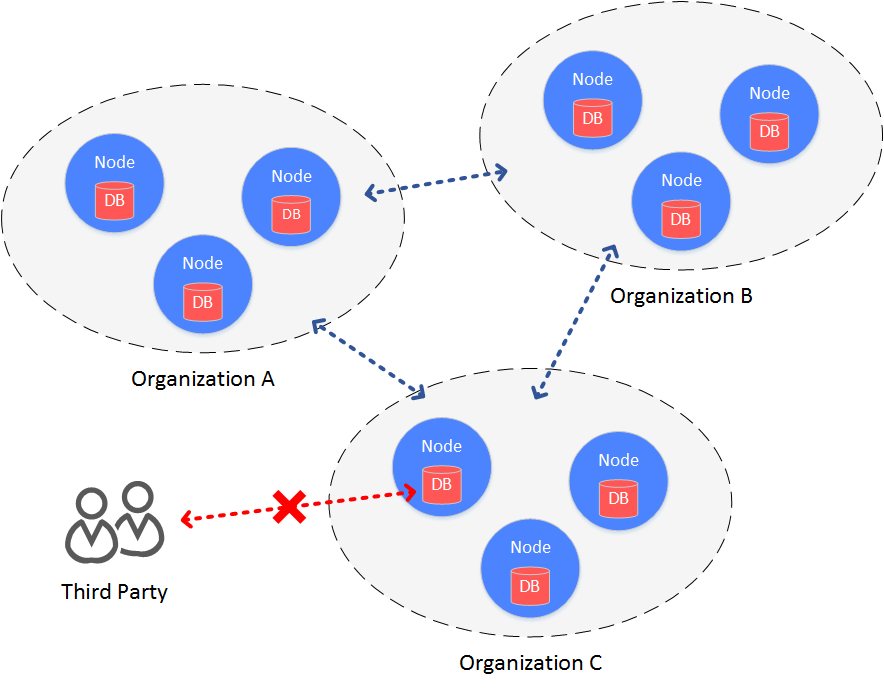
In the architecture of the alliance chain, a blockchain is built between institutions, and data is visible within each institution of the alliance chain。 In some scenarios with high data security requirements, members within the alliance do not want organizations outside the alliance to have access to data on the alliance chain。At this point, you need to access the data on the federation chain。
Access control for federated chain data is divided into two main areas
Access control of communication data on the chain
Access control for node storage data
For access control of on-chain communication data, FISCO BCOS is done through node certificates and SSL。This section focuses on access control for node storage data, i.e., drop disk encryption。
main idea
Falling disk encryption is performed inside the institution。In the organization’s intranet environment, each organization independently encrypts the hard drive data of the node。 When the hard disk of the machine where the node is located is taken away from the organization and the node is started on a network outside the organization’s intranet, the hard disk data cannot be decrypted, the node cannot be started, and thus the data on the alliance chain cannot be stolen。
Programme architecture
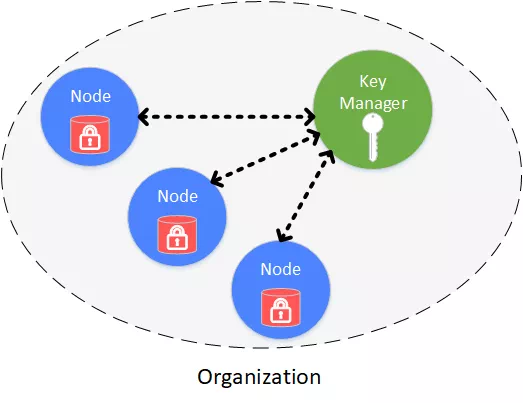
Drop-disk encryption is performed within the organization, and each organization independently manages the security of its own hard drive data。In the intranet, the hard drive data of each node is encrypted。Access to all encrypted data, managed through Key Manager。 Key Manager is deployed in the organization’s intranet and is a service dedicated to managing node hard disk data access keys。When a node in the intranet is started, it obtains the access key for the encrypted data from the Key Manager to access its own encrypted data。
Cryptographically protected objects include:
Database stored locally on the node: rocksdb or leveldb
Node private key: node.key, gmnode.key
realization principle
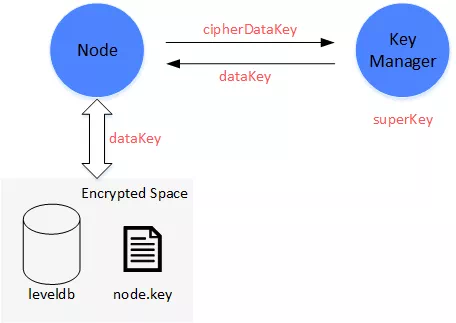
The specific implementation process is accomplished through the dataKey held by the node itself and the global superKey managed by the Key Manager。
Node
The node uses its own dataKey to encrypt and decrypt its own encrypted data (Encrypted Space)。
The node itself does not store the dataKey on the local disk, but stores the encrypted cipherDataKey of the dataKey。
When the node is started, request the cipherDataKey from the Key Manager to obtain the dataKey。 -dataKey is only in the node’s memory. When the node is closed, dataKey is automatically discarded。
Key Manager
Holds the global superKey, which is responsible for responding to authorization requests when all nodes are started。
-Key Manager must be online when the node is started and respond to the start request of the node。
When the node is started, the cipherDataKey is sent. The key manager decrypts the cipherDataKey with the superKey. If the decryption is successful, the node’s dataK is returned to the node。
Key Manager can only be accessed from the intranet, and cannot be accessed from the extranet outside the organization。
Precautions
-Key Manager is a demo version. Currently, superKey is specified at startup through the command line. In practical applications, you need to customize the way to load superKey according to security requirements, such as using an encryption machine to manage。
Disk encryption is configured only for newly generated nodes. Once a node is started, it cannot be converted to a node with disk encryption。
The state secret version encrypts one more private key than the non-state secret version。